In the construction chemicals industry, cellulose ethers play a crucial role as key additives in dry mix mortar, tile adhesives, self-leveling compounds, and wall putty formulations. Among the most widely used cellulose ethers are Hydroxypropyl Methyl Cellulose (HPMC) and Methyl Hydroxyethyl Cellulose (MHEC), both of which serve as thickeners, water retention agents, binders, and film-forming agents. While these two materials exhibit similar functionalities, they differ in key aspects that influence their performance in various construction applications.
This article explores the similarities and differences between HPMC and MHEC, particularly in terms of thermal stability, water retention, and application suitability under different environmental conditions. Understanding these differences can help formulators and construction professionals select the most suitable cellulose ether for their specific requirements.
The key difference between HPMC and MHEC lies in their gel temperature. The gel temperature of HPMC is generally around 60–75℃, depending on the group content and production process, whereas the gel temperature of MHEC is usually above 80℃.
HPMC stands for hydroxypropyl methyl cellulose, while MHEC stands for methyl hydroxyethyl cellulose. Both are important construction chemicals and can be used as thickeners, water retention agents, and air-entraining agents. They are mainly used in cement- and gypsum-based dry mix mortars to improve bond strength, workability, and water retention.
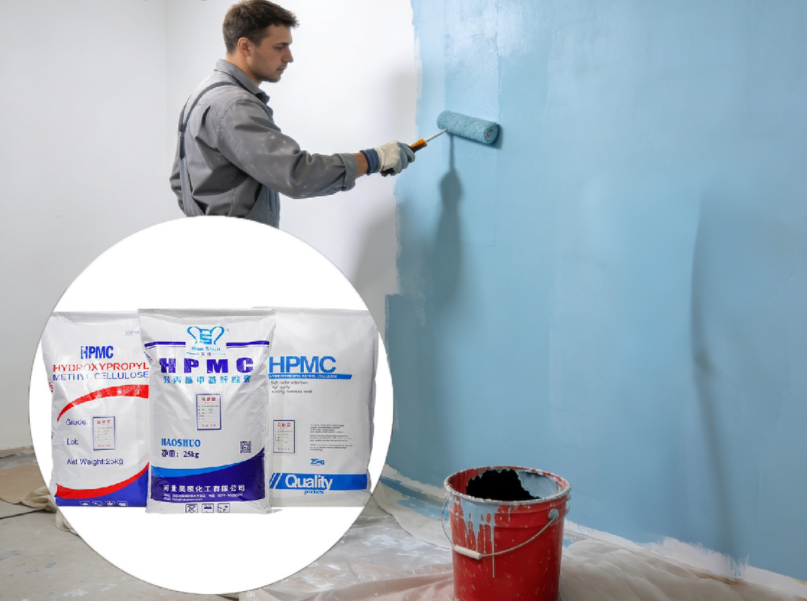
Hydroxypropyl methyl cellulose (HPMC), also known as hypromellose or hydroxypropyl methyl cellulose ether, is produced from highly purified cotton cellulose. The cellulose is first treated in 35–40℃ alkali liquor for 0.5 hours, then squeezed, crushed, and properly aged at 35℃ to ensure that the average polymerization degree of the resulting alkali fiber falls within the required range.
The alkali fiber is then transferred into a reaction kettle, where propylene oxide and methyl chloride are added for etherification at 50–80℃ for 5 hours, with a maximum pressure of 1.8 MPa. Afterwards, an appropriate amount of hydrochloric acid and oxalic acid is added into 90℃ hot water to wash the material and expand its volume. The product is then dehydrated by centrifugation and finally neutralized through repeated washing.
HPMC is widely used in the construction, chemical, coating, pharmaceutical, and military industries, where it serves as a film former, binder, dispersant, stabilizer, and thickener.
The term MHEC stands for methyl hydroxyethyl cellulose. It is a gelling and thickening agent derived from cellulose. The chemical formula of this compound is variable because the number of repeating unit structures per MHEC molecule can differ. Therefore, its molar mass also varies accordingly.
MHEC should be considered instead of HPMC when the mortar formulation must maintain water retention, workability, and application stability under elevated temperatures or demanding jobsite conditions.
Choose MHEC when:
◆ ambient temperature is consistently high;
◆ mortar is applied outdoors under strong sunlight;
◆ substrate temperature rises quickly;
◆ open time becomes noticeably shorter during summer;
◆ standard HPMC grades lose water-retention performance too quickly.
Both HPMC and MHEC are essential cellulose ether additives widely used in dry mix mortar, cement-based plaster, gypsum-based plaster, tile adhesives, wall putty, self-leveling compounds, and EIFS/ETICS systems. Their primary functions include:
Water Retention: Enhances water-holding capacity, preventing premature moisture loss and ensuring proper hydration of cement and gypsum.
Thickening & Workability: Improves the consistency and spreadability of mortar and plaster, enhancing trowelability and reducing sagging.
Adhesion Enhancement: Strengthens the bond between substrate and coatings, improving adhesive performance in tile adhesives and skim coats.
Crack Resistance: Reduces shrinkage and prevents surface cracks in cementitious and gypsum-based applications.
Air Entrainment: Helps introduce controlled air voids to improve workability and freeze-thaw resistance.
Dispersion & Stability: Acts as a protective colloid in the polymerization of vinyl acetate-based emulsions, ensuring stability across a wide pH range.
With these shared properties, both HPMC and MHEC are widely applied in masonry mortars, tile adhesives, grouts, self-leveling flooring, and gypsum-based compounds, making them indispensable in the construction additives industry.
One of the most significant differences between HPMC and MHEC is their thermal stability, which is directly influenced by their gel temperature.
HPMC Gel Temperature: Typically between 60°C and 75°C, depending on the molecular substitution and production process.
MHEC Gel Temperature: Generally higher, at 80°C or above, due to the presence of hydroxyethyl groups.
Why is this important? In hot climates such as Southeast Asia, the Middle East, and India, where mortar application often takes place under high temperatures, the choice of cellulose ether is critical. MHEC’s higher gel temperature ensures better stability in extreme heat, preventing premature gelation and water loss, thereby enhancing workability and reducing the risk of mortar hardening too quickly.
For construction projects in warm and dry environments, MHEC-based formulations are preferable due to their superior performance in hot weather mortar applications.
The hydrophilicity of MHEC is slightly higher than that of HPMC, which results in enhanced water retention at the same dosage and viscosity levels.
HPMC: Excellent water retention properties, making it a reliable choice for general mortar applications.
MHEC: Slightly better water retention due to additional hydrophilic functional groups, making it ideal for hot and dry weather applications where extended open time is required.
In gypsum-based plaster, tile adhesives, and self-leveling compounds, this property can contribute to better workability, open time, and curing performance.
| Formulation / Condition | Starting Choice | Why |
|---|---|---|
| Standard dry mix mortar | HPMC | Good overall performance and cost balance |
| Hot-climate mortar | MHEC | Better suitability for elevated temperatures |
| Summer exterior plaster | MHEC | Helps maintain workable application behavior |
| Standard interior plaster | HPMC | Often sufficient under moderate conditions |
| Hot-weather tile adhesive | MHEC | Useful where open time is difficult to maintain |
| Cost-sensitive general mortar | HPMC | Practical for standard formulations |
| Mortar exported to hot regions | Test MHEC | Climate-specific formulation may be required |
| Existing stable HPMC formulation | Keep HPMC | No need to change without a performance reason |
When selecting the right cellulose ether for construction chemicals, it is essential to consider the environmental conditions and specific formulation requirements:
For general applications: HPMC is a cost-effective and versatile option for plasters, mortars, tile adhesives, and putties.
For high-temperature environments: MHEC is the better choice due to its higher gel temperature and improved thermal stability.
For extended open time and higher water retention: MHEC offers advantages, especially in self-leveling flooring, EIFS/ETICS systems, and hot-weather masonry applications.
HPMC and MHEC are modified cellulose forms mainly used as gelling agents for thickening properties in different items. The key difference between HPMC and MHEC is that the gel temperature of HPMC is around 60–75℃, depending on the group content and different production techniques, whereas the gel temperature of MHEC is usually higher than 80℃.
This is the biggest difference between MHEC and HPMC.
The etherizing agents of HEMC are monochloromethane and ethylene oxide, and its full name is Hydroxyethyl methyl cellulose.
The etherizing agents of HPMC are monochloromethane and propylene oxide, and its full name is Hydroxypropyl methylcellulose, whose synonym is hypromellose.
The gel temperature of HEMC is higher than HPMC. The gel temperature of HEMC is mainly around 75℃ to 100℃, while that of HPMC is around 55℃ to 75℃.
If you are in countries with higher temperature environments, such as India, Indonesia or Africa, you should choose HEMC for your worksite.
Generally speaking, HEMC is a little more expensive than HPMC. The main difference depends on what you care about.
| Problem Observed | Possible Reason | Should You Consider MHEC? |
|---|---|---|
| Mortar dries too quickly in summer | Rapid moisture loss / temperature sensitivity | Yes |
| Open time drops significantly at high temperature | Cellulose ether performance changes under heat | Yes |
| Tile adhesive skins over too early | Fast surface water loss | Consider MHEC |
| Plaster becomes difficult to spread outdoors | Reduced workable time | Consider MHEC |
| Mortar performs well in cool weather but poorly in summer | Temperature-dependent formulation behavior | Strong candidate |
| Standard mortar performs consistently year-round | No significant temperature issue | HPMC may remain sufficient |
HPMC may still be the practical choice when:
◆ the mortar is mainly used under moderate temperatures;
◆ existing water retention already meets formulation requirements;
◆ open time is sufficient;
◆ the current HPMC formulation has stable field performance;
◆ production cost is a major consideration;
◆ there is no proven performance problem requiring a change.
MHEC is not automatically an upgrade from HPMC. The better cellulose ether depends on climate, formulation, application method, substrate, viscosity requirements, and target mortar performance.
For tile adhesive that already achieves sufficient open time under normal conditions, replacing HPMC may offer little practical benefit. However, manufacturers targeting hot-climate markets may evaluate MHEC where premature skinning or shortened adjustment time becomes a recurring problem.
For tile adhesive and exterior plaster, MHEC is especially worth testing when summer temperatures noticeably reduce open time or make the mortar dry too quickly. For masonry mortar, the combination of hot weather and highly absorbent substrates can also justify comparing MHEC with the existing HPMC grade.
For gypsum-based mortar, direct replacement is not recommended without testing because cellulose ether can affect setting behavior and compatibility with other additives.
The key rule is simple: if your current HPMC formulation already provides stable workability, water retention, and open time, there is no need to change it. MHEC should mainly be evaluated when high-temperature conditions create a clear performance problem.
Both HPMC and MHEC play essential roles in cement-based and gypsum-based construction materials by improving workability, adhesion, and durability. Although they share similar properties in thickening, water retention, and adhesion enhancement, they differ in thermal stability and hydrophilicity.
For construction professionals and mortar manufacturers seeking to optimize their formulations, understanding these differences is important when selecting the right cellulose ether for high-performance dry mix mortar, tile adhesives, and wall finishing systems.
By choosing the appropriate HPMC- or MHEC-based formulation, it is possible to achieve better workability, improved durability, and higher application efficiency in different construction environments.
For more information about high-quality HPMC and MHEC for construction chemicals, contact us today to find the most suitable solution for your specific needs.
Related News and Blogs
24
Aug., 2024
Let's meet Indonesia Coatings Exhibition 2024
The 10th Paintistanbul & Turkcoat Fair will be held at the Istanbul Exhibition Center in Turkey from May 8th...
19
Nov., 2021
What Causes A Cracked Putty Layer?
The one-off scraping thickness of the putty is directly proportional to the curing shrinkage strength, which increases in proportion to the tendency of the putty to crack.
04
Nov., 2021
Whether you are carrying out small repairs or building walls, knowing how to mix the mortar needs to be precise. If the mortar is too dry, the blocks will not stick together properly. If it is too wet, flowing mortar can spill out of the joints, resulting in wasted time and materials for clean-up.
25
Oct., 2021
The Effect of Winter Construction Temperature on Tile Adhesives
As we all know, tile adhesive is generally made from cement and mixed with various additives. It is mixed with water at the construction site and then applied to the wall or floor.

Get in Touch
Interested in how our HPMC can enhance your personal care formulations? Contact us to request a free sample and experience the superior quality of our cellulose ether products.