Polyvinyl alcohol, commonly known as PVA or PVOH, is one of the most widely used water-soluble polymers in modern industry. It is extensively applied in adhesives, construction chemicals, textile sizing, paper processing, ceramic binders, coatings, emulsion polymerization, packaging films, and many other industrial applications. Among the numerous grades available on the market, PVA 1788 and PVA 2488 are two of the most commonly used specifications. Although both belong to partially hydrolyzed polyvinyl alcohol products with similar hydrolysis degrees, they differ significantly in viscosity, molecular weight, dissolution behavior, film strength, and final application performance. Understanding these differences is extremely important for manufacturers, formulators, and buyers who want to select the right PVA grade for their production process.
Polyvinyl alcohol itself is not produced directly from vinyl alcohol monomers because vinyl alcohol is chemically unstable. Instead, PVA is manufactured through the hydrolysis or alcoholysis of polyvinyl acetate. During this process, acetate groups are converted into hydroxyl groups, which gives PVA its characteristic water solubility, adhesion, film-forming ability, and chemical resistance. Depending on the degree of hydrolysis and polymerization, different grades of PVA can be produced for specific industrial uses.
To better understand the difference between PVA 1788 and PVA 2488, it is first necessary to understand the meaning of the numbers in the grade designation. In general, the first two digits represent the approximate viscosity or polymerization degree, while the last two digits represent the degree of hydrolysis. For example, PVA 1788 refers to a product with a polymerization degree around 1700 and a hydrolysis degree of approximately 88%. PVA 2488 refers to a higher molecular weight product with a hydrolysis degree also around 88%, but with significantly higher viscosity and stronger mechanical performance.
Both products belong to partially hydrolyzed PVA grades, which means they have excellent water solubility and compatibility with many industrial formulations. However, the difference in polymerization degree creates major differences in their processing characteristics and final performance.
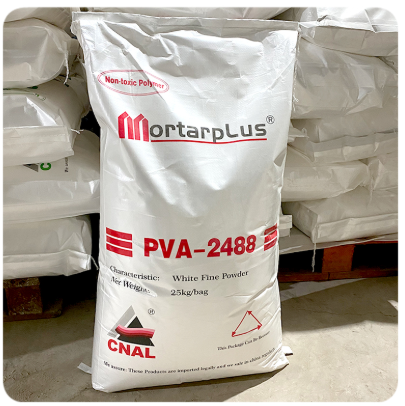
One of the biggest differences between PVA 1788 and PVA 2488 is viscosity. PVA 1788 belongs to the medium-viscosity category, while PVA 2488 is considered a high-viscosity grade. In practical applications, this difference directly affects solution thickness, coating behavior, bonding strength, and film performance.
A 4% aqueous solution of PVA 1788 generally has a viscosity range around 20–26 mPa·s, whereas PVA 2488 may reach 40–65 mPa·s depending on the manufacturer and production standard. Because of its lower viscosity, PVA 1788 dissolves faster and flows more easily during processing. It can usually disperse rapidly in cold water and dissolve efficiently in hot water with relatively short mixing times. This makes it highly suitable for applications requiring easy handling, fast preparation, and lower solution thickness.
PVA 2488, on the other hand, has a higher molecular weight and therefore requires a longer dissolution process. Manufacturers usually need higher temperatures and stronger agitation to fully dissolve the material. However, once dissolved, PVA 2488 produces a thicker and stronger solution with superior tensile strength, higher film toughness, and improved binding capability.
Water solubility is another important consideration when selecting between PVA 1788 and PVA 2488. Both are partially hydrolyzed grades with approximately 88% hydrolysis, meaning they exhibit excellent water solubility compared with fully hydrolyzed grades such as PVA 1799 or 2499.
However, because Haoshuo PVA 2488 has a larger molecular structure and higher viscosity, it takes longer to dissolve completely. PVA 1788 generally dissolves more quickly and produces a smoother solution during processing. This faster dissolution rate makes PVA 1788 especially suitable for industries that require high production efficiency and rapid batching processes.
Another major difference between these two grades is film-forming performance. PVA 1788 generally produces softer and more flexible films. Since it contains slightly lower molecular weight chains, the resulting film has better flexibility and easier processability. In applications such as paper glue, craft adhesives, flexible packaging, and some construction additives, this flexibility is an important advantage.
PVA 2488 creates stronger and denser films with higher tensile strength and better wear resistance. The film formed by PVA 2488 typically shows stronger adhesion to substrates such as paper, textiles, ceramics, and building materials. Because of its stronger intermolecular interactions, PVA 2488 is commonly selected for demanding industrial applications where durability and bonding strength are more important than flexibility.
PVA 1788 is widely used in many industries because of its balanced performance and easy processing characteristics.
In the construction industry, PVA 1788 is commonly used as an additive in cement mortar, tile adhesives, wall putty, gypsum products, and self-leveling compounds. It improves water retention, enhances workability, increases adhesion, and helps reduce cracking.
PVA 1788 is frequently used in school glue, paper adhesives, packaging glue, woodworking adhesives, and office glue products. Its lower viscosity allows easy spreading and smooth application.
In paper manufacturing, PVA 1788 is widely used for paper surface sizing, paper coatings, and paper tube adhesives because of its good flowability and easy dissolution.
Textile manufacturers often use PVA 1788 for yarn sizing and fabric treatment processes where moderate strength and easy desizing are required.
Because of its higher molecular weight and stronger film strength, PVA 2488 is preferred for more demanding industrial applications.
PVA 2488 is widely used in industrial laminating adhesives, carton sealing adhesives, and heavy-duty bonding applications requiring stronger adhesion and higher viscosity stability.
Textile factories frequently select PVA 2488 for warp sizing because it improves yarn strength and abrasion resistance during high-speed weaving operations.
Due to its superior binding properties, PVA 2488 is commonly used as a binder in ceramic products, powder metallurgy, and specialty industrial formulations.
PVA 2488 is also suitable for high-strength paperboard, corrugated packaging, and specialty coated paper products where stronger bonding performance is required.
Many buyers ask whether PVA 1788 or PVA 2488 is the better product. In reality, neither is universally better because each grade is designed for different application requirements.
If your application requires:
· Faster dissolution
· Lower viscosity
· Easier processing
· Flexible film formation
· Cost-effective production
Then PVA 1788 is usually the better choice.
If your application requires:
· Higher viscosity
· Stronger adhesion
· Better tensile strength
· Superior film toughness
· Improved durability
Then PVA 2488 is generally the preferred option.
When selecting between PVA 1788 and PVA 2488, manufacturers should consider several important factors, including:
· Production temperature
· Mixing equipment capability
· Required viscosity
· Film flexibility
· Adhesion strength
· Final product application
· Production efficiency
· Cost control requirements
Choosing the correct grade can significantly improve product performance while optimizing manufacturing costs and production efficiency.
As global demand for environmentally friendly, water-soluble, and high-performance materials continues to grow, both PVA 1788 and PVA 2488 remain important industrial raw materials. Increasing demand from construction chemicals, eco-friendly packaging, textile manufacturing, and industrial adhesives is driving further growth in the PVA market.
Manufacturers are also developing customized PVA formulations to meet the changing needs of modern industries, including improved dissolution performance, higher bonding strength, and better environmental compatibility.
PVA 1788 and PVA 2488 are both important partially hydrolyzed polyvinyl alcohol grades, but they differ significantly in viscosity, dissolution speed, film strength, and industrial applications. PVA 1788 offers faster dissolution, easier processing, and flexible film performance, making it ideal for general-purpose applications. Haoshuo's PVA 2488 provides higher viscosity, stronger adhesion, and superior mechanical properties, making it suitable for heavy-duty industrial use.
Understanding the key differences between these two grades helps manufacturers, distributors, and industrial buyers select the most suitable material for their specific production needs. By choosing the right PVA grade, companies can improve product quality, enhance processing efficiency, and achieve better overall manufacturing performance.
Related News and Blogs
24
Aug., 2024
Let's meet Indonesia Coatings Exhibition 2024
The 10th Paintistanbul & Turkcoat Fair will be held at the Istanbul Exhibition Center in Turkey from May 8th...
19
Nov., 2021
What Causes A Cracked Putty Layer?
The one-off scraping thickness of the putty is directly proportional to the curing shrinkage strength, which increases in proportion to the tendency of the putty to crack.
04
Nov., 2021
Whether you are carrying out small repairs or building walls, knowing how to mix the mortar needs to be precise. If the mortar is too dry, the blocks will not stick together properly. If it is too wet, flowing mortar can spill out of the joints, resulting in wasted time and materials for clean-up.
25
Oct., 2021
The Effect of Winter Construction Temperature on Tile Adhesives
As we all know, tile adhesive is generally made from cement and mixed with various additives. It is mixed with water at the construction site and then applied to the wall or floor.

Get in Touch
Interested in how our HPMC can enhance your personal care formulations? Contact us to request a free sample and experience the superior quality of our cellulose ether products.