Porcelain tile adhesive must maintain a reliable bond even after prolonged exposure to water. This is more difficult than bonding conventional ceramic tiles because porcelain has an extremely dense body and very low water absorption. Porcelain tiles classified as Group BIa typically absorb no more than 0.5% water, leaving little opportunity for the adhesive to develop a bond through surface absorption.
For this reason, cement hydration alone may not provide sufficient adhesion, especially in bathrooms, kitchens, balconies, swimming pool surrounds, and other wet areas. Adding redispersible polymer powder (RDP) helps create a polymer-modified tile adhesive with better adhesion, flexibility, and resistance to moisture-related bond loss.
Traditional ceramic tiles have a relatively porous back. Fresh cementitious adhesive can wet this surface and penetrate its pores, creating mechanical interlocking as the mortar cures.
Porcelain tile behaves differently. Its compact, vitrified surface absorbs very little water and offers fewer pores for the cement paste to enter. Technical installation guidance therefore recommends polymer-modified adhesives for porcelain tiles because ordinary low-polymer cementitious mortars may not provide a sufficiently reliable bond.
The challenge becomes greater when the installation is exposed to water. Any weakness at the tile–adhesive interface may become visible after the mortar has been saturated.
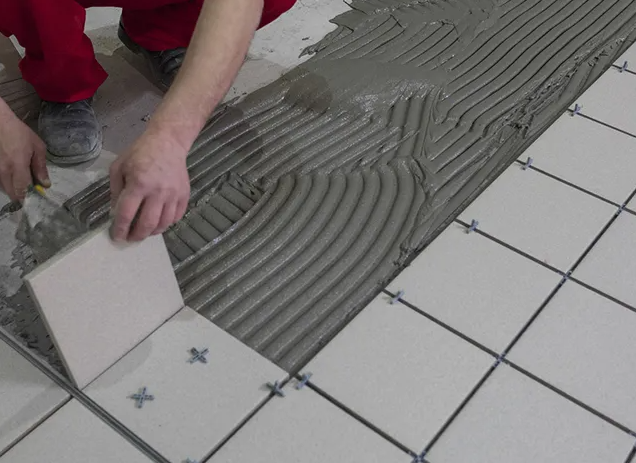
When a cured tile adhesive is immersed, water gradually enters its capillary pores. Saturation can affect the bond in several ways:
◆ Water may penetrate weak or incomplete contact areas behind the tile.
◆ The cementitious matrix may lose some apparent stiffness when saturated.
◆ Expansion and shrinkage differences can create stress at the interface.
◆ Poorly formed polymer films may soften or lose cohesion.
◆ Voids can collect water and concentrate stress during later temperature changes.
Water immersion testing therefore evaluates more than simple “water resistance.” It tests whether the entire adhesive system maintains sufficient tensile adhesion after extended moisture exposure.
A strong dry result does not automatically guarantee strong wet adhesion. An adhesive may perform well after standard curing but fall below its target after immersion if the polymer grade, dosage, cement system, water ratio, or curing conditions are unsuitable.
RDP is produced by spray-drying a polymer dispersion into a free-flowing powder. When the dry-mix adhesive is combined with water, the powder redisperses into fine polymer particles.
As cement hydration and drying continue, these particles come together and form a polymer phase throughout the mortar. The polymer can create bridges between the cementitious matrix, mineral fillers, substrate, and porcelain tile surface. This improves adhesion and cohesion while allowing the hardened adhesive to accommodate limited movement.
In porcelain tile adhesive, RDP contributes to wet bond performance through four main effects:
The polymer phase improves contact with the dense back of porcelain tiles, where mechanical anchoring is limited. This reduces dependence on tile absorption.
RDP reinforces the internal structure of the adhesive. A more cohesive mortar is less likely to fracture within the adhesive layer during pull-off testing.
Porcelain tile, mortar, and substrate respond differently to moisture and temperature. The polymer-modified matrix distributes these stresses more effectively than a rigid, unmodified cement mortar.
Polymer bridges can restrict the growth of small cracks caused by shrinkage or movement. Fewer connected cracks also mean fewer direct paths for water to reach the bonding interface.
However, RDP should not be described as making tile adhesive completely waterproof. It improves moisture durability, but the final performance still depends on the complete formulation and installation system.
EN 12004-1 classifies cementitious tile adhesives according to their adhesion performance. For tensile adhesion strength after water immersion, the minimum requirements are:
| Adhesive classification | Minimum tensile adhesion after water immersion |
|---|---|
| C1 cementitious adhesive | ≥ 0.5 N/mm² |
| C2 improved cementitious adhesive | ≥ 1.0 N/mm² |
C2 adhesives must also meet the higher 1.0 N/mm² threshold after standard curing, heat ageing, and freeze–thaw exposure.
Under the EN 12004-2 procedure, cementitious adhesive specimens are conditioned under standard laboratory conditions and then immersed before tensile pull-off testing. The test uses fully vitrified Group BIa ceramic tiles, making it particularly relevant to porcelain tile adhesive development.
Formulators should not aim only to reach the minimum value. A reasonable performance margin is important because raw-material variation, mixing water, temperature, and production consistency can all affect the final result.
Different polymer chemistries do not provide identical water resistance, flexibility, or adhesion. A general-purpose RDP may improve dry strength but may not be the best choice for C2 porcelain tile adhesive. The selected grade should be designed for cementitious mortars and verified under water-immersion conditions.
A typical laboratory screening range may be approximately 2–5% of the dry formulation, depending on the required adhesive class and polymer grade. This is only a starting point. Adding more RDP does not always produce a proportional increase in wet adhesion and may change water demand, setting, consistency, and cost.
Cement type, cement content, carbonate filler, sand grading, and supplementary binders determine the strength and porosity of the mineral matrix. RDP cannot compensate for an unstable cement system or poorly graded aggregate.
HPMC or MHEC controls water retention, open time, wetting, and application consistency. Insufficient water retention may cause premature drying and incomplete cement hydration. Excessive viscosity or poor rheology can prevent full contact with the tile back. For this reason, formulators should understand how HPMC and RDP work together in tile adhesive.
Too much water increases porosity after drying and may reduce cohesive strength. Too little water can limit cement hydration and make full adhesive transfer difficult. Use the same controlled water-to-powder ratio when comparing laboratory samples.
Early water exposure can interrupt cement hydration and polymer film formation. Test samples and actual installations need adequate curing before immersion or service exposure.
Do not evaluate only the numerical pull-off result. Record the failure location as well:
◆ Failure between tile and adhesive: Check RDP grade, dosage, open time, surface wetting, skinning, and adhesive transfer.
◆ Failure within the adhesive layer: Review cement content, water ratio, air content, filler grading, and polymer level.
◆ Failure between adhesive and substrate: Examine substrate cleanliness, absorption, strength, and surface preparation.
◆ Failure within the substrate: The adhesive bond may be stronger than the substrate itself.
Photographing each failure surface provides valuable information for formulation adjustment and batch comparison.
RDP for porcelain tile adhesive is essential when the formulation must maintain bond strength after water immersion. It improves adhesion to the tile’s low-absorption surface, reinforces mortar cohesion, increases flexibility, and helps control microcracking.
Nevertheless, wet adhesion depends on more than polymer dosage. RDP chemistry, cellulose ether, cement, fillers, mixing water, curing, and test preparation must be optimized as one system. The most reliable approach is to establish a controlled reference formula, change one variable at a time, and verify performance according to EN 12004 rather than judging the adhesive only by its dry bond strength.
Previous: None
Related News and Blogs
24
Aug., 2024
Let's meet Indonesia Coatings Exhibition 2024
The 10th Paintistanbul & Turkcoat Fair will be held at the Istanbul Exhibition Center in Turkey from May 8th...
19
Nov., 2021
What Causes A Cracked Putty Layer?
The one-off scraping thickness of the putty is directly proportional to the curing shrinkage strength, which increases in proportion to the tendency of the putty to crack.
04
Nov., 2021
Whether you are carrying out small repairs or building walls, knowing how to mix the mortar needs to be precise. If the mortar is too dry, the blocks will not stick together properly. If it is too wet, flowing mortar can spill out of the joints, resulting in wasted time and materials for clean-up.
25
Oct., 2021
The Effect of Winter Construction Temperature on Tile Adhesives
As we all know, tile adhesive is generally made from cement and mixed with various additives. It is mixed with water at the construction site and then applied to the wall or floor.

Get in Touch
Interested in how our HPMC can enhance your personal care formulations? Contact us to request a free sample and experience the superior quality of our cellulose ether products.